news and events
Celebration of Life
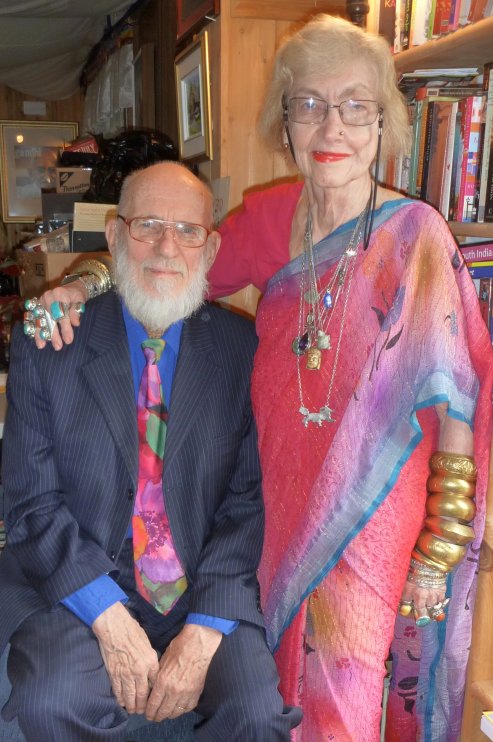
Fred Cappuccino, a founder of Child haven International, left his earthly form on August 6th, 2026 while holding the hand of his beloved wife Bonnie and surrounded by many of his 21 children, and their children as well.
Fred’s 100 years began on January 28th 1926 in Scranton, Pennsylvania. Drawn to the ministry, he studied at Drew University in New Jersey, Crozer Theological Seminary in Pennsylvania and Garrett Biblical Institute in Illinois. He also spent three years in Japan working with young people and teaching English through song after World War 2.
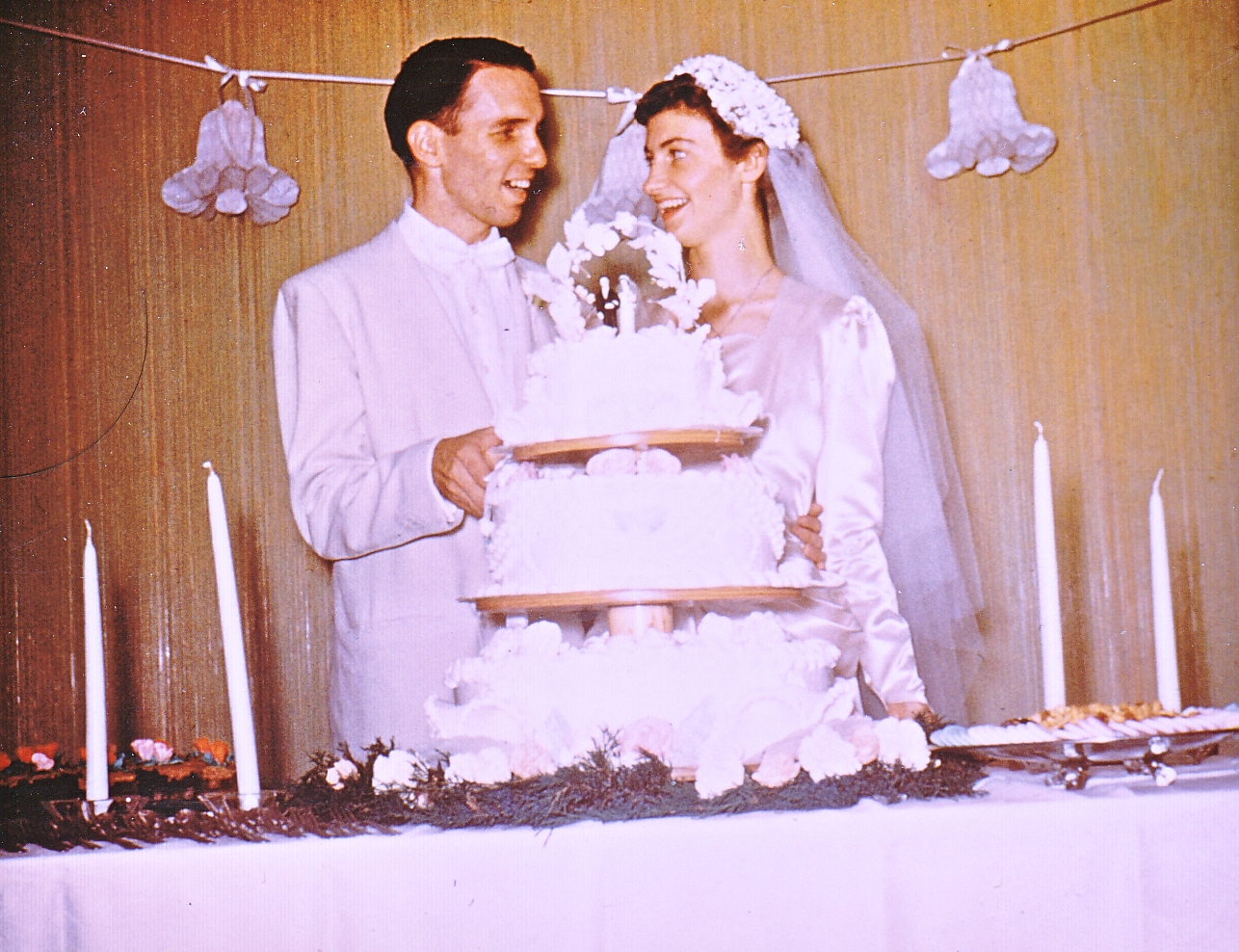
It was at Garrett that Fred met the love of his life, Bonnie McClung. Fred and Bonnie were married in 1953 in Dundee, Illinois. He was a 27-year-old Methodist minister and Bonnie McClung, a 19-year-old student nurse, raised on farms in Illinois and Minnesota.
From the beginning the Cappuccinos shared a passion for social justice. They decided to have only two children born to them, in keeping with Zero Population Growth. Two sons were born to them, and nineteen children, 11 boys and 8 girls, were adopted from eleven different cultural and national backgrounds. In 1955, their first adoption, a tiny half Japanese, half black 5-year-old child from Japan, created a rift in their Chicago Methodist congregation and a third of the members left. Fred said that “the fear was that we were bringing blacks into the community,” adding that the 1950s was a different time, full of fear. The rest of the congregation was supportive, but racial tensions continued to run high. In 1963, Fred decided to leave the Methodist ministry and become a Unitarian Universalist minister, serving a congregation in Silver Spring, Maryland, a suburb of Washington, D.C. Meanwhile, the family continued to grow.
While there the Cappuccino family joined the 1963 March on Washington and heard the famous "I Have a Dream" speech by Martin Luther King Jr. Two years later, Fred joined the Selma, Alabama Civil Rights March upon hearing that his fellow Unitarian minister and good friend, James Reeb, had been brutally beaten there by angry white segregationists. While Fred was there, James died of his wounds. The five-day Gandhian non-violent standoff between the marchers and the police in Selma was successful, contributing to the enactment of the Civil Rights Act in 1965. Fred recalled being moved to tears over and over again by the bravery of the local community. He shared that "the outsiders could go home to safety, but the local people had to endure." He also brought home stories of the humour, and improvised freedom songs that uplifted the collective spirit and resolve.
The Cappuccinos' opposition to the Vietnam War helped draw them to Canada in 1967. Fred became minister at the Lakeshore Unitarian Church in Pointe Claire, Quebec. It was there that a group led by Bonnie, with Fred’s support, formed Families For Children (FFC), to help needy children in overseas countries to find adoptive homes with Canadian and U.S. families. They also established an orphanage for those who couldn't be adopted.
As part of their Families for Children work, the Cappuccinos began a series of overseas trips that would continue for decades. In 1972 they travelled to Bangladesh to rescue 16 war-orphaned babies.
Fred left his Lakeshore job in 1974, and the family moved permanently into a 170-year-old log house, in Maxville, Ontario, Their pioneer-built home was located halfway between Ottawa and Montreal on 100 acres of rocky fields and woodland. There they continued to help run Families for Children, raised their many children, and revelled in rural life. Fred also worked as a therapist in an extended-care home.
In 1976, the Cappuccino family temporarily pulled up their stakes at their Maxville farm, sold almost everything they owned and moved with their 7 youngest children to Sri Lanka and India for 16 months. There they established a Children’s Home in Coimbatore, India for 400 children.
In 1985, on leaving FFC, the Cappuccinos, together with their family doctor, Natubhai Shah, launched a new charity, Child Haven International. Child Haven now supports 1,300 formerly destitute children in India, Nepal and Bangladesh. An additional Home in Tibet was eventually closed by the Chinese government. Another aspect of Child Haven’s work is uplifting the lives of local women through direct employment, education, medical aid, legal aid, and vocational training opportunities.
Fred was a strong supporter of unions and worker’s rights, and would jump at the opportunity to join a picket line belting out Solidarity Forever and union anthems in his soaring baritone to the delight of all on his side of the line.
The Cappuccinos have won many awards for their work including the Order of Canada in 1996, the Baha’i Race Unity Award, and the UNESCO Prize for “The Teaching of Human Rights”. But their biggest satisfaction came not from awards and recognition but from the work itself, in which they found great joy and sustenance.
Fred said it all started when he married an eccentric young woman who loved children. “My problem is she knows I’m totally enchanted with her, and she takes advantage,” he would laugh.
 In his humorous 2015 tome entitled, Bonnie and her 21 Children, Fred wrote, "Bonnie had pre-school children in our family for an uninterrupted period of 26 years… No husband should have to endure such massive inconvenience and disruption." In fact, he loved it and fully supported enlarging the family. He was thankful for each new member of his family.
Fred’s life was a testament to the power of active love and the belief that each child regardless of where they are born, the colour of their skin, gender, caste, or religion, are precious wondrous beings, each possessing unique and precious gifts that only they can offer to the world.
Novelist Shilpi Somaya Gowda, one of their Child Haven patrons, sums up the Cappuccinos this way: "Bonnie and Fred have lit a lamp for the whole world to see."
A Celebration of Life for Fred Cappuccino on November 7th at 4PM at the First Unitarian Congregation of Ottawa. Recorded broadcast live on the link below.
The program includes brief testimonials from a few of Fred's friends and family, some of his favorite songs opened and closed with some of his favorite melodies played on the bagpipes whose soaring tones were much beloved by Fred
broadcast link: Celebration of Life
Contributions in Fred's memory can be sent to the Fred Fund for Education, a part of our Child Haven International Endowment Fund

Children of Child Haven
A recent article on Child Haven by Ajit Jain published by theIndiandiaspora
 Toronto: All of 80 and smiling, Bonnie Cappuccino weighs 110 lbs and always wears a saree, perfectly matched with over five pounds of Indian jewelry (believe it!). With a goody bag for company, she travels four times a year from Maxville to the Child Haven International – a Canadian charitable home with centers across India, Nepal, Bangladesh and Tibet....read more
Latrine Doctor to the Rescue!
Dr S. V. Mapuskar has designed the bio-gas and water treatment plants for many of our Indian Child Haven homes.
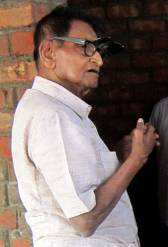
In our Winter 2013 Newsletter there is a very important article, written by Robin Cappuccino, regarding Dr Mapuskar's work, titled "Latrine Doctor to the Rescue!".
Below are 2 documents you can download, that Dr Mapuskar gave Robin Cappuccino, which relate to this article.
Septic Tank Latrine As A Treatment Unit For Human Excreta in rural India – Pros & Cons
Diploma Programme in Water, Sanitation, Hygiene and Public Health (WASH)
sanitary napkin-making system
Bonnie made a special trip to Coimbatore, on the other side of Tamil Nadu State, to meet Muruganathan. Below is a condensation of an article about this incredible man in the March 16, 2012 issue of the GUARDIAN WEEKLY by Lakshmi Sanhana of the OBSERVER. 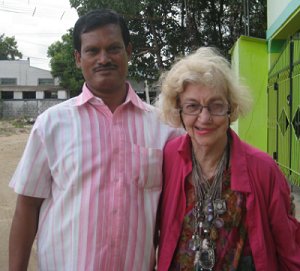
Muruganathan, who lived below the poverty line, began research into sanitary towels when he saw his wife, Shanti, trying to slip away with some filthy rags. When questioned, she said the choice was buying towels for herself or buying milk for the family.
88% of women in India resort to using ashes, newspapers, dried leaves, etc. during their periods. Many women suffer severe reproductive tract infections. Muruganathan determined to create a low-cost towel for his wife.
He started out by purchasing cotton and made a few samples. Unaware of menstrual cycles, he presented them to his wife and demanded immediate test results. But his wife and sisters refused to discuss his creations with him.
When his sisters saw him coming they’d shout loudly to his wife next door saying that if he was going to ask them about towels, he’d better go back home. Undaunted, he approached female medical students, and when they refused to enter into discussion, gave them feedback forms. Convinced that he was using sanitary towels to get close to other women, his wife left him.
He decided to test them himself, using goat’s blood. He wore a bladder and tube contraption for a week. Unsatisfactory results prompted him to try another approach. He distributed towels free and asked women to return the used ones. “It wasn’t easy,” he says. “They thought I would use them for black magic.” For his mother, stumbling on a storeroom of used sanitary towels was the final straw. She left too.
His breakthrough came after two years of testing various materials. He finally hit upon cellulose made from pine bark. Reclaiming the fibers into usable cellulose required a machine costing $470,000. He decided to make a simpler version. Some years later his machine won a prestigious award and commendation from the President of India. He was able to persuade his family to come back.
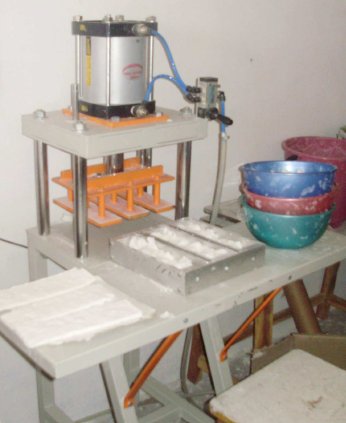
At this writing he has made 600 machines, installed across India. In spite of numerous offers, he refuses to sell his innovation to the corporate world.” I didn’t take the money route because I saw my parents struggle for survival. I knew this machine could provide a sustainable livelihood for many rural women.
The machine now sells for $5000. Child Haven will install the first one at our womens project in Ghaziabad (see page one). It will provide employment for five women, and sell sanitary napkins that are affordable. We will set up machines at other Child Haven sites as funds become available.
child haven bicycle fundraiser across canada
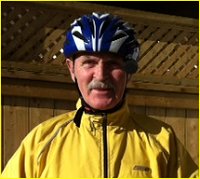
Sean Collins, a 62-year-old grandfather is biking across Canada Fund raising for Child Haven.
Email Sean:
 sean@childhaven.ca
Blog:
 childhaveninternational.blogspot.ca/
We have setup a Blog to follow Sean's progress, and for you to post messages of encouragement and support.
 Follow Sean on google map http://goo.gl/maps/eLq6
bio-gas system now in hyderabad home
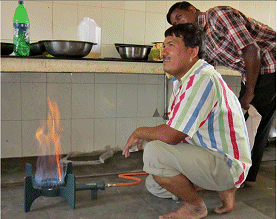 Rajesh lights the first bio-gas flame with William looking on. The bio-gas system, transforming waste from the homes toilets, should provide up to a third of the gas for our cooking needs
Child Haven Book Now Available Online
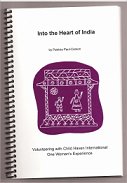 Patricia Paul-Carson spent three months in our Gandhinagar Home. Her 148 page book, INTO THE HEART OF INDIA, tells her story as a Child Haven intern - the highs and lows, joys and frustrations, new-found friendships and loneliness. Her diary provides insight into interning or/and volunteering in developing countries. She can be reached at ppaulcarson@rogers.com
Click on the book cover to read or download her book.
Kaliyampoondi Building Project
A brick wall is currently being built around the perimeter of the four acre compound. By making our own bricks, the cost is reduced by half. Local staff is building the wall.
Because of drought there are severe water problems. The huge well on the property is often dry. On the advice of water experts, the well has been drilled sideways in three directions, resulting in more flow of water. Drilling a second deep well is being planned for another part of the compound.
Another urgent need is for a third major building for a larger dormitory for the girls.
Gandhi’s Secretary becomes a Patron of Child Haven International
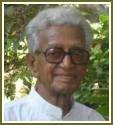
V. Kalyanam, a very spry and energetic octogenarian, agreed in early 2009 to serve as a Patron of Child Haven International and board member of Child Haven International / India. Among his previous responsibilities was acting as Gandhi’s personal secretary from 1944 till his death in 1948.
Recently in his Chennai flat he spoke of his time working with Gandhi.
V. Kalyanam, a very spry and energetic octogenarian, has agreed to serve as a Patron of Child Haven International and board member of Child haven International / India. Among his previous responsibilities was acting as Gandhi’s personal secretary from 1944 till his death in 1948.
An avid gardener, his home in Chennai is circled by hundreds of potted plants that he attends daily. Kalyanam joined Gandhi’s Sevagram Ashram in 1944, hoping to help with gardening and other community chores. Upon his arrival he discovered that Gandhi, and most of his personal staff were locked up in prison. Shortly thereafter, Gandhi was released, earlier than the others, due to illness and weakness resulting from fasting. Upon learning that Kalyanum could speak a few languages and type with one finger, Gandhi quickly recruited him as a secretary to help reply to the hundreds of letters he received every day.
During a recent visit with Child Haven volunteers and staff, Kalyanam laughingly referred to Gandhi “abusing” him in this way by making him into a secretary when he could just barely type at all.
Over tea he made and served in his Chennai flat he regaled Child Haven International Director, Bonnie Cappuccino, Kaliyampoondi Child Haven Home Chief Administrator Batthu, and several Child Haven interns with recollections of his time working with Gandhi. He recalled how especially in the beginning, it was very difficult to understand what Gandhi was saying when he spoke without his dentures – all he could make out was a kind of “Whush whush whush”. However it was on a day when Gandhi didn’t speak at all that he received his first scolding from the Mahatma. It was Gandhi’s custom to spend Mondays as a day of silence between sunrise and sunset. One such Monday, Gandhi and company were traveling on a long journey by train. Gandhi passed a note to Kalyanam that he needed to reply to a letter from the British Viceroy as soon as possible, and handed him the hand written text to be typed and sent. Kalyanam took the letter, but not having a typewriter with him, resolved to send it the next day when he would have a typewriter available. That sunset, the first thing Gandhi asked was where the letter was as it had to be sent immediately. When Kalyanam protested that he didn’t have his typewriter, Gandhi replied, “When I go to see a barber, I expect him to have his scissors!” A chagrined Kalyanam borrowed a barely functional typewriter from someone else on the train and the letter was sent in the nick of time. Needless to say he kept a typewriter close at hand at all times from then on.
Kalyanam has chosen a simple life with no servants or staff, and until recent 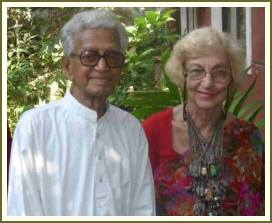 knee problems began, swept the street in front of his apartment as part of a daily ritual and community service. He is a frequent letter to the editor writer, admonishing others to remember Gandhi’s lessons, most especially governmental officials with whom he is sometimes quite disappointed. Often asked to speak about his time with Gandhi, Kalyanam also sponsors periodic displays of Gandhi memorabilia in his care. He shared with his Child Haven visitors several of these items. One was the yellowing police post-mortem written following Gandhi’s assassination. It describes the fatal bullet-wounds, made by a pistol, “a very dangerous weapon”.
Kalyanam has made several visits to Child Haven’s Kaliyampoondi home and promises to make many more. On his visits he not only shares the inspiration of his life and experiences, but also has brought several specimens of the plants from his garden. Indeed as his Child Haven visitors prepared to return to Kaliyampoondi, he insisted on sending along part of a delicate and quickly spreading ground-cover which a friend had just given him. Child Haven is very pleased and appreciative to have Kalyanam’s advice and involvement with our homes. We look forward to his thoughts, ideas and memories spreading as quickly and well as the ground cover and other plants he so generously shares with us.
KEEPING CHILD HAVEN 'GREEN'
Child Haven homes employ numerous practices to help keep our planet healthy, including:
Everest Base Camp Trek
Tourcan Vacations' exciting guided trek to the Everest Base Camp includes visits to the Nepal Child Haven Home, monasteries, and hiking over snowcapped rocks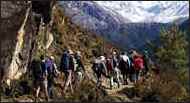 and glaciers, through forests and rivers before reaching the Base Camp at 17998 feet. The trek fee includes a $250 donation to Child Haven International.
Click on image to learn more.